Is Your Stadium Ready for AI? The Real Bottleneck Is Data, Not Algorithms
AI is moving from buzzword to boardroom priority in stadiums, but the real challenge is not adopting new tools. The venues that will win are those that can unify trusted, real-time data across operations, security, concessions, and fan experience systems. Without that foundation, AI will only expose inefficiencies faster rather than fix them.

AI has become a board-level issue across sports, stadium, and live-event operations. Venue leaders are no longer asking whether the technology matters; they are asking where it creates value, how quickly it should be deployed, and whether their infrastructure is ready to support it.
The business case is clear. AI can improve operating efficiency, reduce labor friction, and strengthen commercial performance through better conversion, higher per-cap spending, and more effective premium utilization. But in stadiums, the technology itself is not the main constraint. The real bottleneck is whether the venue can surface trusted, real-time signals from across its systems.
That distinction matters. AI only creates value when the underlying data is accurate and connected. If the inputs are fragmented or unreliable, the outputs will be too. In that sense, AI does not eliminate the old problem of bad data; it amplifies it.
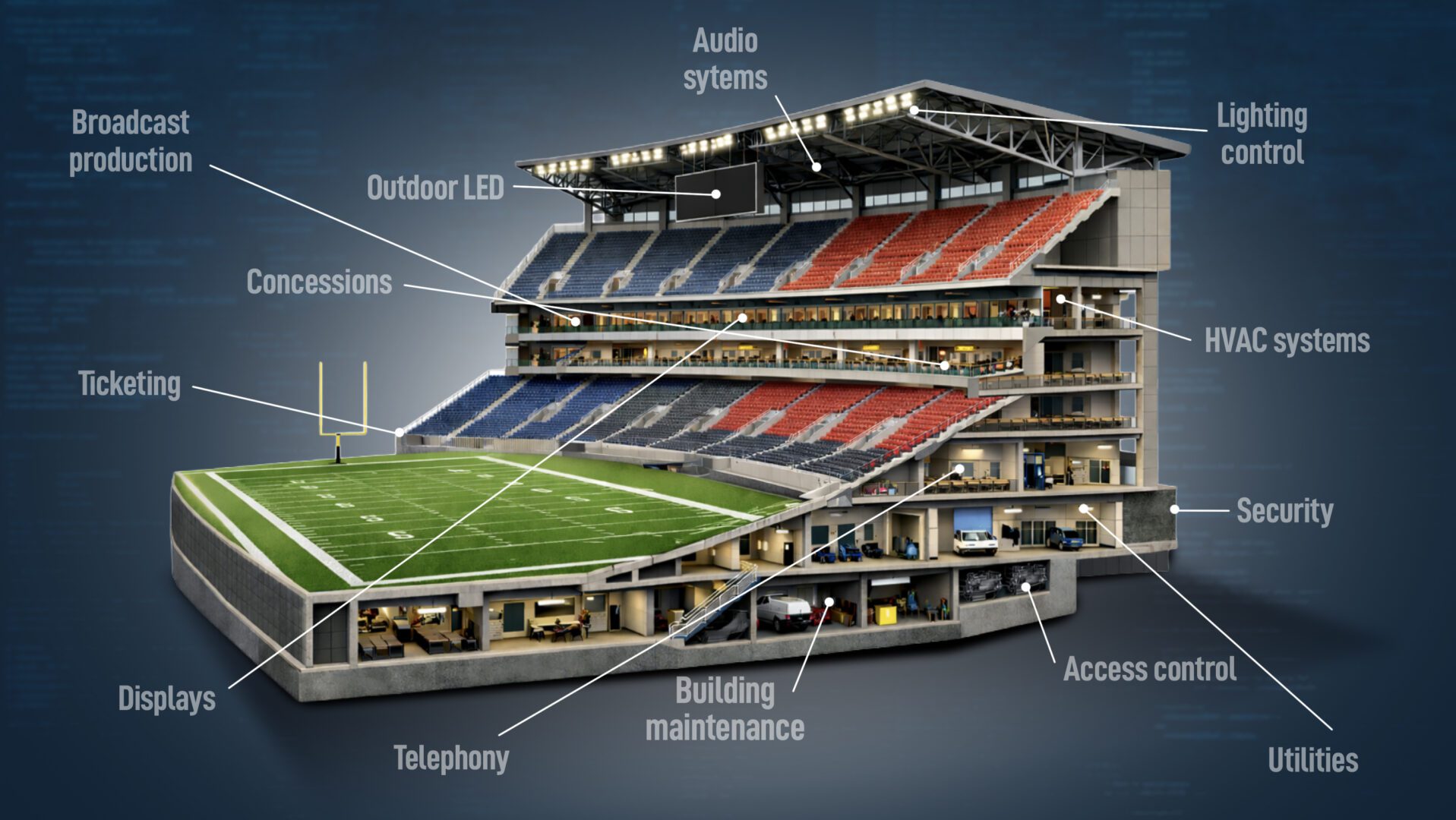
Many venues have already invested in AI tools and are now asking why the returns are not showing up in day-to-day operations. The answer is structural. Most stadiums were not built as unified digital businesses. They evolved department by department, with ticketing, operations, security, concessions, marketing, and team systems often developed separately and frequently through third-party platforms.
The result is a patchwork of silos that makes even basic operational questions difficult to answer quickly and confidently. If a venue cannot get a fast, trusted answer from its systems, AI will not transform performance. It will simply make the disconnect more visible.
That is why the next phase of stadium technology is less about experimentation and more about operational architecture. The venues that get value from AI will be the ones that can connect physical activity with digital intelligence in real time, so decisions can be made during the event rather than after it.
That requires a data model built around three priorities: speed, trust, and actionability. Real-time signals from computer vision, LiDAR, ticketing, and point-of-sale systems can reveal how fans are moving, where queues are forming, and where demand is building. A unified data platform can then standardize the operational facts around occupancy, ingress flow, service speed, and congestion so every department is working from the same view.
This is where the business disruption becomes clear. Stadiums are no longer just physical venues; they are data environments. The competitive advantage will belong to operators that can see what is happening, remember it in a trusted system, decide quickly, and prove the impact with measurable outcomes.
That framework is especially powerful because it ties technology investment directly to business results. Leaders do not need more dashboards for their own sake. They need systems that help them improve throughput, reduce risk, optimize staffing, and increase revenue in the moments that matter most.
A strong example comes from a major tennis event, where crowd-flow analytics revealed that large LED screens intended to enhance the fan experience were also contributing to congestion in certain areas. By correlating movement data with content playback, the venue was able to adjust programming to improve both safety and circulation. Multiple departments could act on the same information in real time.
That kind of visibility is exactly where AI can move the needle. But adoption is not frictionless. Trust remains one of the biggest barriers. Stadium operations still rely heavily on experience and instinct, and if AI-generated insights do not match what staff see on the ground, confidence drops quickly. Building trust requires clear interpretation, strong governance, and a workflow that helps people understand how to act on the data.
Infrastructure is another factor that is often underestimated in AI conversations. Fiber and power remain foundational. If a venue has enough capacity in both, it is better positioned to support future technology. If not, every new capability becomes more expensive and more difficult to scale.
Edge computing is also becoming more important as venues process larger volumes of sensor and video data. By handling more analysis closer to where the data is generated, stadiums can respond in real time without overwhelming network capacity, while still sending information to the cloud for broader insight and long-term planning.
That architectural balance matters because stadiums do not operate like conventional enterprise environments. Events begin on schedule whether systems are ready or not, and technology must perform under peak load with little tolerance for downtime. AI deployments in this environment need to be built for live-event pressure, not just office-hour convenience.
Third-party systems will continue to play a role, but venues cannot afford to let vendor complexity block access to their own data. Automating pipelines, strengthening governance, and reducing manual preparation will be essential if stadium teams are going to spend less time cleaning data and more time using it.
The next wave of competitive advantage in sports venues will not come from algorithms alone. It will come from organizations that have aligned their infrastructure, data, and operating model so that AI can actually improve decisions in the moment.
The stadiums that are ready for AI will not simply have more technology. They will have the ability to see what is happening, trust the information, and act on it with confidence. In a business defined by live moments, that capability may become one of the most valuable assets a venue can own.
Why It Matters
AI is moving from buzzword to boardroom priority in stadiums, but the real challenge is not adopting new tools. The venues that will win are those that can unify trusted, real-time data across operations, security, concessions, and fan experience systems. Without that foundation, AI will only expose inefficiencies faster rather than fix them.