Stadium networks are evolving into the operating system of the modern venue
Stadium connectivity is no longer just about keeping fans online on game day. As venues add sensors, automation, security, retail, and building systems, the network is becoming the core infrastructure that powers operations, revenue, and risk management. This shift is forcing operators to rethink capital spending, vendor strategy, and long-term facility design.
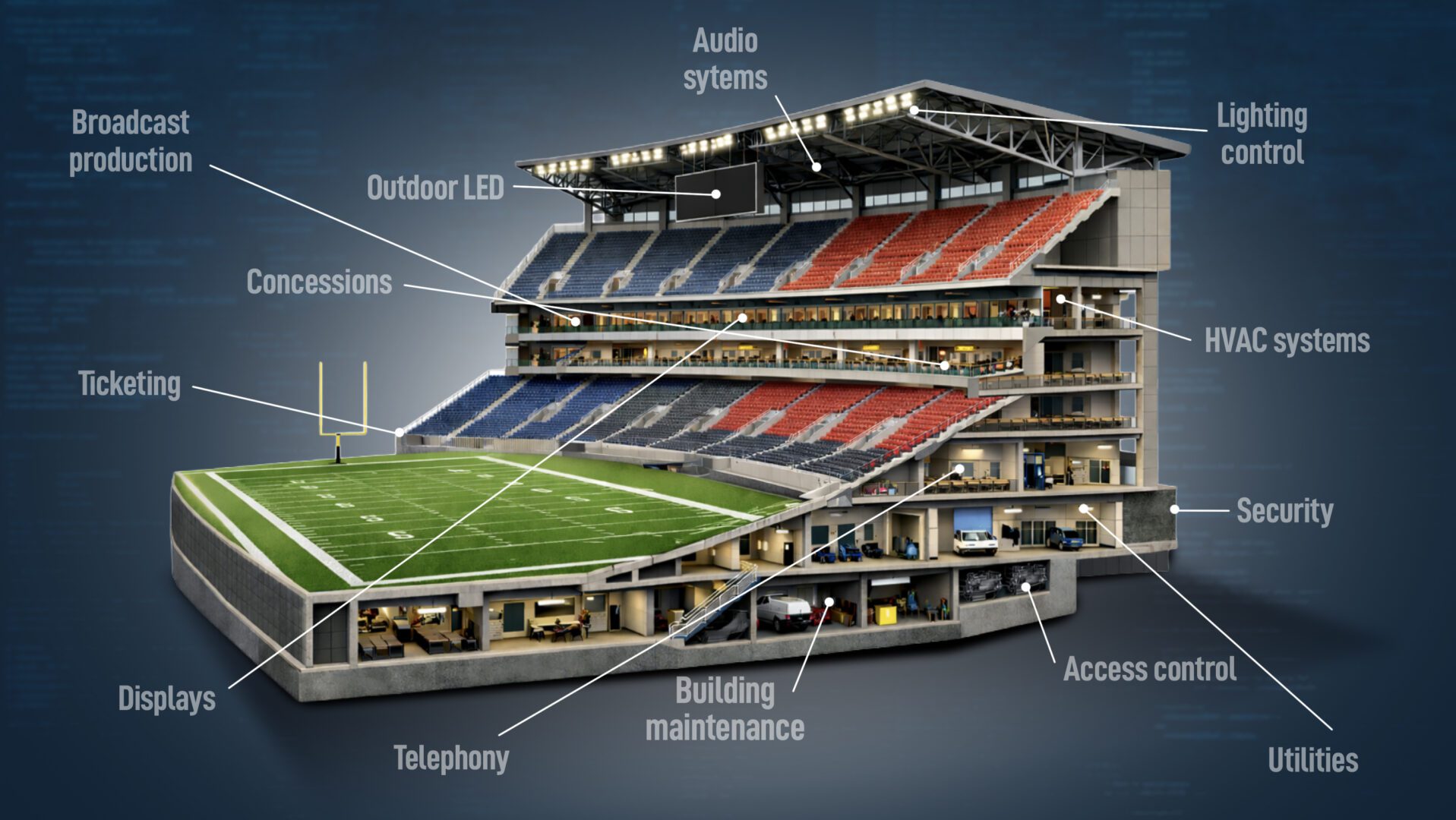
Stadium infrastructure is moving into a more consequential era, and with it, the economics of venue technology are changing. Networks that were once designed mainly to deliver fan Wi-Fi are now being asked to support sensors, automation platforms, embedded intelligence, and machine-to-machine communication across the entire building.
That evolution reflects a larger shift in commercial real estate, where connected devices are projected to reach 39 billion worldwide by 2030. As artificial intelligence increases the demand for real-time operational data, venues are confronting more traffic, more endpoints, more security exposure, and more pressure to treat connectivity as essential infrastructure rather than a back-end utility.
Inside stadiums, the first major transformation has already taken place. High-density Wi-Fi turned venues into large-scale consumer connectivity platforms, capable of serving tens of thousands of devices on event day. But that model is no longer enough on its own. Stadiums are now layering in systems for HVAC, lighting, security, broadcast, retail, and building operations, creating a patchwork of networks that were built for reliability but increasingly function as expensive silos.
That fragmentation carries direct business consequences. Every isolated network adds its own maintenance requirements, upgrade cycles, security protocols, and technical expertise. As more operational systems come online, complexity compounds, driving up capital expenditure and operating costs while increasing the financial risk tied to downtime.
The next major growth driver is operational IoT. Building automation, security analytics, frictionless commerce, asset tracking, robotics, and predictive maintenance are already reshaping commercial facilities because they improve efficiency and can unlock new revenue streams. In stadiums, those same use cases could quickly double the number of endpoints over the next decade, creating a denser and more demanding operating environment.
An even more disruptive layer is beginning to emerge: ambient IoT. Ultra-low-power sensors, battery-free tags, continuously connected wearables, and embedded intelligence could push endpoint counts far beyond today’s levels. In a high-traffic venue, that could mean hundreds of thousands of connected devices during peak operations, with sensor density approaching one device per 20 square feet.
For stadium owners and operators, the implication is clear. The network is no longer just a fan-experience platform. It is becoming the digital backbone of the venue, supporting revenue generation, safety, and building performance at the same time. That changes the investment case for network architecture, vendor selection, and long-term facility planning.
As device counts continue to rise, traditional network strategies will struggle to keep pace. Software-defined and converged architectures are likely to become essential, giving venues the ability to segment traffic, scale capacity dynamically, and manage multiple systems through a more unified framework. The operators that benefit most will be the ones that turn complexity into a competitive advantage instead of allowing it to become a cost center.
Why It Matters
Stadium connectivity is no longer just about keeping fans online on game day. As venues add sensors, automation, security, retail, and building systems, the network is becoming the core infrastructure that powers operations, revenue, and risk management. This shift is forcing operators to rethink capital spending, vendor strategy, and long-term facility design.
Content Package
Stadium networks are evolving fast. What started as high-density Wi‑Fi for fans is turning into the digital backbone for safety, revenue, and building performance. As IoT and ambient sensing grow endpoint counts dramatically, operators will need software-defined, converged architectures to avoid costly network silos and downtime risk. Read more from Stadium Tech Report.
#StadiumTech#SmartStadium#IoT#NetworkArchitecture#SportsTech
Stadium Wi-Fi was step one. Now venues face AI-driven, multi-system connected device growth—HVAC, security, retail, IoT, even ambient sensors. Networks must evolve into core digital infrastructure. #StadiumTech
#StadiumTech#SmartStadium#IoT
Stadium technology is entering a more complex era—and the business implications are immediate. For years, venue networks were designed primarily to support fans: high-density Wi‑Fi for smartphones and tablets on game day. That model worked because the “endpoint universe” was relatively predictable. But commercial real estate is shifting fast. Connected devices are projected to surge toward 39 billion worldwide by 2030, with AI increasing the demand for real-time operational data. In stadiums, that translates to more network traffic, more security risk, and more pressure on operators to treat connectivity as core infrastructure—not a back-of-house utility. What’s changed inside venues 1) Network fragmentation is becoming expensive Stadiums are layering in separate systems for HVAC, lighting, security, broadcast, retail, and operations. What once focused on reliability is increasingly turning into costly silos—each requiring its own maintenance, upgrades, security controls, and specialized expertise. 2) Operational IoT is driving a new growth wave Building automation, security analytics, frictionless retail, asset tracking, robotics, and predictive maintenance are all gaining traction. In stadiums, these use cases can quickly double the number of endpoints over the next decade—raising complexity and increasing the cost of downtime. 3) Ambient IoT could be the real inflection point Ultra-low-power sensors, battery-free tags, continuously connected wearables, and embedded intelligence could push endpoint counts far beyond today’s levels. In high-traffic venues, peak sensor density could approach one device per 20 square feet. The investment case: networks as the digital backbone The network is no longer just a fan experience platform. It’s becoming the digital backbone supporting revenue generation, safety, and building performance. That changes the investment case for network architecture, vendor selection, and long-term facility planning. Why traditional strategies won’t hold As device counts rise, traditional network approaches struggle to keep up. Segmentation, scaling, and unified management become essential. Software-defined and converged architectures are likely to be the path forward—helping venues segment traffic, scale capacity dynamically, and manage multiple systems through a more unified framework. Bottom line: the winners will be the operators who turn complexity into operational advantage, rather than letting it compound into a cost center. What are you seeing in your venue ecosystem—more vendor-specific networks, or a move toward converged, software-defined connectivity?
#StadiumTech#SmartStadium#IoT
Stadiums aren’t just Wi‑Fi anymore 📡➡️ HVAC, security, retail + IoT + ambient sensors = new network reality. Connectivity must be the digital backbone. Are you ready? #StadiumTech #IoT #SmartStadium #NetworkSecurity #SportsTech #EdgeAI #ConnectedDevices
#StadiumTech#SmartStadium#IoT
Stadium networks are evolving fast. The days of “fan-only” Wi‑Fi are fading as venues connect HVAC, security, retail systems, and growing IoT (even ambient, ultra-low-power sensors). With more endpoints comes more traffic, higher security risk, and rising costs—making connectivity a core infrastructure investment, not a back-of-house utility.
#StadiumTech#SmartStadium#IoT
In 2026, stadium networks aren’t just for fans anymore. 📱 At first, stadiums upgraded Wi‑Fi and called it a day. But now the venue is connecting everything: HVAC, lighting, security, retail systems, operations… plus IoT. And the next wave? Ambient IoT—battery-free sensors, ultra-low-power tags, continuously connected wearables. That could mean hundreds of thousands of devices at peak. So the question isn’t “Do we have Wi‑Fi?” It’s: can your network scale securely and manage multiple systems without turning into expensive silos? Software-defined + converged architectures are quickly becoming the play. Are you building for the game day… or for the entire venue?
#StadiumTech#SmartStadium#IoT
Stadium tech is entering a new connected era. Here’s what’s changing. First, stadiums built high-density Wi‑Fi for fans—great for smartphones and tablets. Now, venues are adding connected systems: HVAC, lighting, security, broadcast, retail, and operations. That often creates network silos—more maintenance, more upgrades, more security work, and bigger downtime risk. Next comes operational IoT: predictive maintenance, asset tracking, frictionless retail, automation. Endpoints multiply. And then ambient IoT could push device counts dramatically higher—battery-free sensors and ultra-low-power tags could create sensor density near “one per 20 square feet” during peak. Bottom line: the network is becoming the digital backbone of the stadium. The winners will adopt software-defined, converged architectures that scale securely and unify management. What system in your venue is the most connected today?
#StadiumTech#SmartStadium#IoT
Stadium networks = the new “operating system.” From IoT + security to retail + predictive maintenance, fragmentation is costly. Software-defined + converged architectures are the path forward. 🏟️✨ #StadiumTech #IoT #SmartStadium #NetworkEngineering #VenueManagement #SportsTech
#StadiumTech#SmartStadium#IoT#NetworkArchitecture#SportsTech
Stadium Wi‑Fi isn’t enough anymore. Networks are evolving into the venue’s “operating system” for IoT, security, retail, broadcast, and building performance—so architecture and segmentation become the real competitive edge. #StadiumTech
#StadiumTech#SmartStadium#IoT#NetworkArchitecture#SportsTech
Stadium technology is entering a new phase—and the business stakes are rising. For years, stadium networks were built primarily to keep fans connected. High-density Wi‑Fi turned venues into large-scale consumer connectivity platforms, capable of supporting tens of thousands of devices on game day. But today’s stadium is no longer just a connectivity venue. It’s an operational ecosystem. As artificial intelligence and real-time analytics drive demand for live data, venues face: - more traffic and more endpoint density - expanded security exposure - tighter uptime expectations - growing pressure to treat connectivity as core infrastructure The challenge: network fragmentation. Stadiums are layering additional systems—HVAC, lighting, security, broadcast, retail, and day-to-day operations—often resulting in multiple networks that were designed for reliability but have become expensive silos. Each isolated network adds maintenance requirements, upgrade cycles, security protocols, and specialized expertise. Complexity compounds, increasing both capital expenditures and operating costs while raising business risk tied to downtime. What’s next is operational IoT—followed by ambient IoT. Building automation, security analytics, frictionless retail, asset tracking, robotics, and predictive maintenance are already reshaping commercial facilities. In stadiums, these use cases could double endpoint counts over the next decade. And the more disruptive layer is emerging: ultra-low-power sensors, battery-free tags, continuously connected wearables, and embedded intelligence. In a high-traffic venue, that could mean hundreds of thousands of connected devices during peak operations—pushing sensor density toward “one device per 20 square feet.” So what does this mean for owners and operators? The network is becoming the digital backbone of the modern venue—supporting revenue, safety, and building performance at the same time. That shifts the investment case for network architecture, vendor selection, and long-term facility planning. To keep pace, traditional network strategies won’t be enough. Software-defined and converged architectures will likely be essential to segment traffic, scale capacity dynamically, and manage multiple systems through a unified framework. The winners won’t just “add connectivity.” They’ll turn complexity into competitive advantage—before it becomes a cost center. #StadiumTech #VenueOperations #IoT #NetworkArchitecture #SmartStadium #PropTech
#StadiumTech#SmartStadium#IoT#NetworkArchitecture#SportsTech
Stadium Wi‑Fi used to be the goal. Now it’s just the beginning. 🏟️ Today’s venue has sensors, automation, security analytics, smart retail, and even predictive maintenance—all needing constant, reliable connectivity. But when networks are split into separate “silos” for each system, costs rise: more upgrades, more maintenance, more security overhead, and higher downtime risk. The next shift? Stadium networks becoming the venue’s operating system—powered by software-defined, converged architectures that can segment traffic and scale dynamically. In short: the network isn’t support anymore. It’s the backbone. Would you rather scale with one unified platform—or keep adding more separate networks?
#StadiumTech#SmartStadium#IoT#NetworkArchitecture#SportsTech
Stadiums are changing—and so are their networks. 🏟️ For years, Wi‑Fi was about fan connectivity. But now the venue is an ecosystem: HVAC, lighting, security, broadcast, retail, operations—and AI-driven real-time insights. Here’s the problem: network fragmentation. When each system runs on its own network, you get extra maintenance, upgrade cycles, security protocols, and technical expertise. Complexity compounds—and so do costs and downtime risk. The future is operational IoT, then ambient IoT. That means far more endpoints—potentially hundreds of thousands during peak moments. So what’s the solution? Software-defined and converged architectures that segment traffic, scale capacity dynamically, and manage multiple systems through a unified framework. Bottom line: the network is becoming the digital backbone—and the real competitive advantage. Want a smart-stadium checklist for what to look for? Comment “OS.”
#StadiumTech#SmartStadium#IoT#NetworkArchitecture#SportsTech
Stadium Wi-Fi is no longer enough. With sensors, automation, and AI, venue networks are becoming the “operating system” that powers safety, revenue, and building performance. Complexity is rising—so must the architecture.
#StadiumTech#SportsTech#IoT#SmartVenues#NetworkArchitecture
Stadium technology is moving into a new commercial phase—and the economics are changing fast. For years, venue networks were primarily built to keep fans connected. High-density Wi‑Fi made stadiums large-scale consumer connectivity platforms—tens of thousands of devices on game day. But that model is now evolving into something more fundamental: the venue’s operating system. Why the shift? Because AI and operational demand are driving a step-change in real-time data needs—more traffic, more endpoints, and a larger security attack surface. At the same time, stadiums are layering connectivity across mission-critical systems: HVAC, lighting, security, broadcast, retail, and day-to-day operations. The result is often a patchwork of networks. Originally designed for reliability, these systems can become costly silos—each with its own maintenance burden, upgrade cycle, security protocols, and specialized expertise. As operational systems multiply, complexity compounds: higher capex and opex, plus increased business risk from downtime. What’s next is even more transformative: - Operational IoT (building automation, security analytics, frictionless retail, asset tracking, robotics, predictive maintenance) - Ambient IoT (ultra-low-power, battery-free sensors, continuously connected wearables, embedded intelligence) In a high-traffic venue, endpoint counts can scale dramatically—potentially hundreds of thousands during peak operations—pushing sensor density toward “one device per 20 square feet.” For stadium owners and operators, the takeaway is clear: connectivity can’t remain a support function. It becomes the digital backbone supporting revenue generation, safety, and building performance simultaneously. That changes the investment case for: - Network architecture (moving toward software-defined and converged approaches) - Vendor selection (integration maturity and lifecycle support) - Long-term facility planning (designing for growth, not just today’s device counts) The venues that pull ahead won’t just “manage networks”—they’ll turn complexity into competitive advantage instead of a cost center. What’s your organization prioritizing right now: unified architecture, security posture, or operational IoT readiness?
#StadiumTech#SportsTech#IoT#SmartVenues#NetworkArchitecture
Stadium networks aren’t just for Wi‑Fi anymore—connectivity is becoming the venue’s operating system. 🏟️🤖 Sensors + AI + automation = smarter operations + safer days. Are you ready? #StadiumTech #IoT #SportsTech #NetworkSecurity #SmartVenues #OperationalIoT #AmbientIoT #AI #VenueManagement
#StadiumTech#SportsTech#IoT#SmartVenues#NetworkArchitecture
Stadium Wi‑Fi was just the start. Now networks must run HVAC, security, retail, automation, and AI data—turning connectivity into the venue’s “operating system.” Fragmented networks raise cost and downtime risk.
#StadiumTech#SportsBusiness#IoT#SmartStadium#NetworkInfrastructure#VenueOperations#CyberSecurity#AI
Stadium networks are entering a more consequential phase. For years, venue connectivity was built to solve one problem: keeping fans online. High-density Wi‑Fi turned stadiums into large-scale consumer connectivity platforms—capable of serving tens of thousands of devices on game day. But the business model is shifting. Today, stadium infrastructure is being asked to support far more than phones and tablets: machines, sensors, automation platforms, broadcast systems, retail enablement, and embedded intelligence across the entire building. And this isn’t happening in isolation—commercial real estate is moving toward massive endpoint growth (projected to reach ~39B connected devices worldwide by 2030). Add AI’s demand for real-time operational data, and venues face more traffic, more endpoints, and more security exposure. The challenge: fragmentation. Many stadiums have layered new systems over time—HVAC, lighting, security, operations, and more—creating patchwork networks that were designed for reliability but function like expensive silos. Each isolated network introduces its own maintenance requirements, upgrade cycles, security protocols, and specialized expertise. The result is compounded complexity: higher capex and opex, plus increased business risk tied to downtime. What’s next: operational IoT → ambient IoT. Operational IoT (building automation, security analytics, frictionless retail, asset tracking, robotics, predictive maintenance) is already improving efficiency and opening new revenue paths. The next disruption is ambient IoT: ultra-low-power sensors, battery-free tags, continuously connected wearables, and embedded intelligence. In a high-traffic venue, endpoint counts could jump dramatically—potentially hundreds of thousands during peak operations—pushing sensor density toward “one device per ~20 square feet.” So what should stadium owners and operators do? The network can’t remain a “support function.” It’s becoming the digital backbone for revenue, safety, and building performance—and that changes the investment case for: • Network architecture (how you scale, segment, and isolate systems) • Vendor selection (capabilities, integration, and long-term support) • Long-term facility planning (designing for endpoint growth, not just today’s game-day load) Converged, software-defined approaches are likely to become essential. They help venues segment traffic, scale dynamically, and manage multiple operational systems through a unified framework. The operators who win won’t just “add more connectivity.” They’ll turn complexity into competitive advantage—using the network as the operating system of the modern venue.
#StadiumTech#SportsBusiness#IoT#SmartStadium#NetworkInfrastructure#VenueOperations#CyberSecurity#AI
Stadium Wi‑Fi is evolving fast ⚡️📡 Networks now power security, HVAC, retail, automation & AI data. Fragmented systems = higher costs + downtime risk. Build for IoT now. #StadiumTech #IoT #SmartStadium #SportsTech #NetworkInfrastructure #AI #VenueOperations
#StadiumTech#SportsBusiness#IoT#SmartStadium#NetworkInfrastructure#VenueOperations#CyberSecurity#AI
Stadium technology is moving from “keep fans connected” to “run the entire venue.” As operational IoT and ambient sensing grow, fragmented networks across HVAC, security, retail, and broadcast can drive up costs and downtime risk. The future belongs to software-defined, converged network architectures that treat connectivity as core infrastructure.
#StadiumTech#SportsBusiness#IoT#SmartStadium#NetworkInfrastructure#VenueOperations#CyberSecurity#AI
Stadium technology is entering a new era. As AI and operational IoT expand, venue networks are shifting from “keeping fans online” to becoming the digital backbone for safety, revenue, and building performance. But fragmented networks create rising costs and downtime risk—making software-defined, converged architectures increasingly critical. What’s the biggest network challenge your venue faces today?
#StadiumTech#SportsTech#IoT#SmartVenues#NetworkArchitecture
Hook (0-5s): Stadium Wi‑Fi was the upgrade… but now the network has to run EVERYTHING. Scene 1 (5-15s): Today’s venues are adding sensors, automation, security analytics, asset tracking, and AI-driven operations. That means far more devices, more data, and more pressure on reliability. Scene 2 (15-28s): If networks are fragmented into silos—HVAC here, security there—maintenance and security headaches multiply, and downtime becomes expensive. Scene 3 (28-40s): The winning move? Software-defined, converged architectures that segment traffic and scale dynamically—so the network becomes the venue’s operating system. Close (40-45s): Stadiums: Wi‑Fi to backbone. Are you building for IoT now?
#StadiumTech#SportsBusiness#IoT#SmartStadium#NetworkInfrastructure#VenueOperations#CyberSecurity#AI
Stadiums used to treat connectivity as a fan-experience feature. Now it’s the venue’s operating system. Here’s why: venues are layering in HVAC controls, security analytics, automation platforms, frictionless retail, broadcast systems, and predictive maintenance. That means massive endpoint growth—far beyond what traditional Wi‑Fi alone can handle. The problem is fragmentation. When each system lives on its own network, you get separate maintenance, upgrade cycles, security protocols, and specialized teams. Complexity compounds—costs rise and downtime risk increases. The solution? Software-defined and converged network architectures. They let venues segment traffic, scale capacity dynamically, and manage multiple systems through one unified framework. Bottom line: the network isn’t just for fans anymore—it’s core infrastructure for safety, revenue, and building performance.
#StadiumTech#SportsBusiness#IoT#SmartStadium#NetworkInfrastructure#VenueOperations#CyberSecurity#AI
Stadium Wi‑Fi used to be the headline. Now it’s the foundation. 🏟️ Here’s what’s changing: stadiums are adding sensors, automation, and embedded intelligence—HVAC, lighting, security, retail, operations. That means way more devices, more data, and more security risk. The old approach—multiple separate networks—turns into expensive silos. Maintenance, upgrades, and troubleshooting become harder every season. So what’s next? Stadium networks are becoming the venue’s operating system. Software-defined and converged architectures help venues segment traffic, scale capacity, and manage everything through one unified framework. Bottom line: the network isn’t just a fan-experience tool anymore—it’s core infrastructure. Are you building for the next wave of IoT?
#StadiumTech#SportsTech#IoT#SmartVenues#NetworkArchitecture
Stadium Wi‑Fi was step one. Step two is bigger: stadium networks are becoming the venue’s operating system. 🏟️ Why? Because AI and operational IoT are turning venues into data-driven environments—connected HVAC, lighting, security analytics, retail systems, asset tracking, and predictive maintenance. But there’s a catch: if these systems run on fragmented networks, complexity compounds. More maintenance. More upgrades. More security protocols. Higher costs—and greater downtime risk. The solution gaining momentum: software-defined and converged network architectures. They can segment traffic, scale dynamically, and manage multiple systems in a unified framework. In short: connectivity is shifting from “supporting” the venue to actively powering safety, revenue, and building performance. Are you treating your network like core infrastructure yet?
#StadiumTech#SportsTech#IoT#SmartVenues#NetworkArchitecture